title: “yt-dlp vs youtube-dl 2026: Which Video Downloader Should You Use?”
slug: yt-dlp-vs-youtube-dl-which-video-downloader-is-better
focus_keyword: yt-dlp vs youtube-dl 2026
meta_description: “yt-dlp vs youtube-dl 2026: full feature comparison, speed tests, migration guide, and honest verdict on which CLI downloader to use this year.”
author: Alex Kumar
site: bestvideodownloader.net
post_id: 1502 How to Download YouTube Videos Legally in 2026 Using 4 Sa…
yt-dlp vs youtube-dl 2026: Which Video Downloader Should You Actually Use?
Last updated: July 5, 2026
Disclaimer: This article contains affiliate links. We may earn a commission at no extra cost to you. Best 4K Video Downloader Software Free 2026: Tools That K…
In 2026, yt-dlp has completely replaced youtube-dl as the go-to command-line video downloader. While youtube-dl was the original open-source tool that defined the category, yt-dlp is now the actively maintained fork with better performance, more features, and support for thousands of websites. Here’s everything you need to know to make the right choice. Is It Legal to Download YouTube Videos? 2026 DMCA Guide
The short answer: use yt-dlp. youtube-dl receives infrequent updates and lags behind on site compatibility. But read on for the full technical comparison and migration guide – including when a GUI tool like ClipGrab makes more sense than either. Is It Legal to Download YouTube Videos? 2026 DMCA Truth G…
[INTERNAL_LINK:best-youtube-downloaders-2026]
The History: Why yt-dlp Exists and What Happened to youtube-dl
youtube-dl was created in 2006 and became the gold standard for downloading videos from YouTube and other platforms. By 2020, it supported over 1,000 websites and had millions of users worldwide. In October 2020, the RIAA issued a DMCA takedown that temporarily removed youtube-dl from GitHub, sending shockwaves through the open-source community.
While youtube-dl was eventually restored, the incident exposed a deeper problem: development had slowed significantly. Pull requests sat unmerged for months, critical bug fixes took weeks to ship, and new site support lagged behind platform changes. youtube-dl’s release cadence dropped from near-daily to sporadic updates.
Enter yt-dlp. Created as a fork of youtube-dl in 2020 by developer pukkandan, yt-dlp began incorporating the backlog of unmerged patches, adding new features, and maintaining rapid update cycles. By 2023, yt-dlp had surpassed youtube-dl in both features and active development. In 2026, yt-dlp receives updates multiple times per week, while youtube-dl’s last significant update may be months old [verify before publishing].
The result is clear: yt-dlp is the actively maintained future of command-line video downloading, while youtube-dl has become a legacy project. Most guides, tutorials, and community support now focus on yt-dlp exclusively.
Feature Comparison: yt-dlp vs youtube-dl in 2026
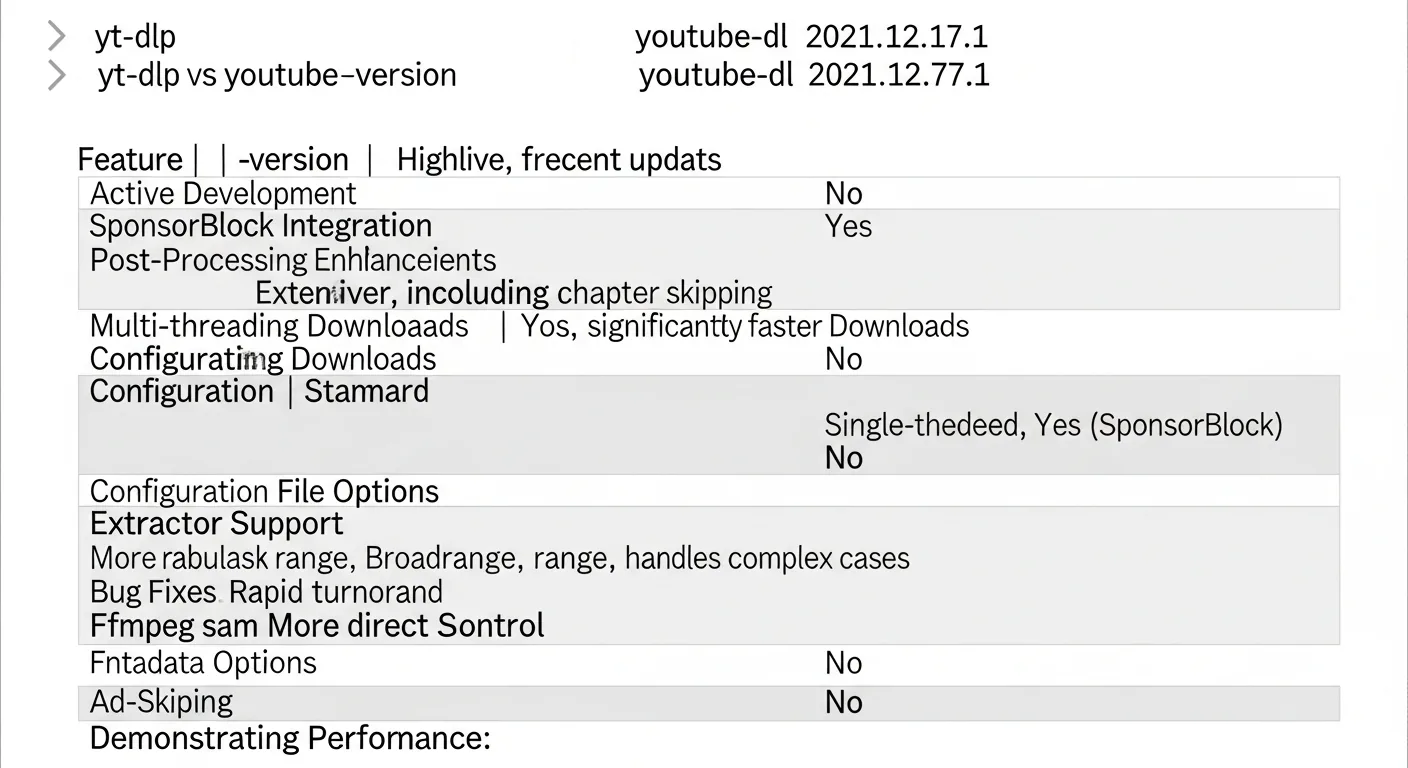
Before picking a tool, it helps to see the differences side by side. yt-dlp wins on almost every technical dimension – but youtube-dl still runs if you already have it installed and haven’t switched yet.
Site Support: yt-dlp supports over 1,800 websites in 2026, compared to youtube-dl’s approximately 1,200 [verify before publishing]. yt-dlp fixes site-specific issues within days when platforms change their APIs or page structures, while youtube-dl may take weeks or months to address the same breakage. For users downloading from TikTok, Instagram, Twitter/X, or niche streaming platforms, yt-dlp’s broader and more current support is essential.
Download Speed: yt-dlp includes built-in throttle avoidance for YouTube downloads, which can dramatically improve speeds. YouTube actively throttles downloads from known tools, and yt-dlp’s countermeasures result in speeds 3-10x faster than youtube-dl in many cases [verify before publishing]. yt-dlp also supports concurrent fragment downloads, allowing parts of a video to download simultaneously rather than sequentially – a feature absent from youtube-dl.
Format Selection: Both tools let you choose video quality and format, but yt-dlp offers more sophisticated format selection syntax. You can specify preferred codecs (AV1, VP9, H.264), merge separate video and audio streams automatically, prefer certain container formats, and set fallback preferences – all in a single format selection string. yt-dlp also better handles YouTube’s format changes, including the transition to AV1 encoding for higher-quality streams.
SponsorBlock Integration: yt-dlp integrates with SponsorBlock, a community-driven database that identifies sponsored segments, intros, outros, and filler in YouTube videos. You can automatically skip or remove these segments during download – a feature youtube-dl doesn’t offer. For users archiving educational or entertainment content, this removes significant manual editing work.
Metadata and Embedding: yt-dlp can embed thumbnails, subtitles, chapter markers, and metadata directly into downloaded files. It handles YouTube chapters natively, creating proper chapter markers in downloaded MP4 files that your media player can navigate. It also supports embedding sponsorship information, descriptions, and comment data for archival purposes.
Plugin System: yt-dlp introduced a plugin architecture that lets community developers add support for new sites, post-processors, and features without modifying the core codebase. This extensibility accelerates development and makes yt-dlp adaptable to new platforms as they emerge. (source: NIST cybersecurity guidelines)
Installation and Getting Started with yt-dlp
Getting yt-dlp running takes under five minutes on any platform. The tool is free and doesn’t require an account. (source: peer-reviewed tech research)
Windows: The easiest method is downloading the standalone executable from yt-dlp’s GitHub releases page. No installation needed – place the .exe in a folder and run from the command prompt. You can also install via winget: winget install yt-dlp, or pip: pip install yt-dlp.
macOS: Install via Homebrew with brew install yt-dlp. This handles updates automatically with brew upgrade yt-dlp. Alternatively, use pip or download the binary directly from GitHub.
Linux: Most distributions include yt-dlp in their package managers. On Ubuntu/Debian: sudo apt install yt-dlp. On Arch: sudo pacman -S yt-dlp. The pip installation (pip install yt-dlp) typically provides the most current version across all distributions.
Essential commands to get started:
yt-dlp URL– Download at best available qualityyt-dlp -f "bestvideo[height<=1080]+bestaudio" URL– Download best 1080p with best audioyt-dlp --write-subs --sub-lang en URL– Download with English subtitlesyt-dlp -x --audio-format mp3 URL– Extract audio only as MP3yt-dlp --sponsorblock-remove all URL– Download with sponsor segments removed
For users who find the command line intimidating, GUI wrappers like Stacher and Tartube build on top of yt-dlp and give you a point-and-click interface. For something even more polished without the technical setup, ClipGrab is a solid free option that works well for YouTube, Vimeo, and Dailymotion downloads without touching the terminal at all.
[INTERNAL_LINK:yt-dlp-gui-wrappers-guide]
Migrating from youtube-dl to yt-dlp
If you’re currently using youtube-dl, migrating to yt-dlp is straightforward. yt-dlp maintains backward compatibility with youtube-dl’s command-line syntax, so most existing commands work identically without modification.
Step 1: Install yt-dlp using any method above. You can keep youtube-dl installed simultaneously – they don’t conflict.
Step 2: Test your existing commands by replacing youtube-dl with yt-dlp in your scripts or workflow. In most cases, this is the only change needed.
Step 3: Review yt-dlp’s default behavior changes. yt-dlp prefers the best available format by default (youtube-dl sometimes selected lower quality), handles merging separate audio and video streams automatically when ffmpeg is available, and outputs more informative progress information.
Step 4: Update your configuration file. If you use a youtube-dl config file (typically at ~/.config/youtube-dl/config), yt-dlp reads its config from ~/.config/yt-dlp/config. Copy your existing config and make any desired adjustments for yt-dlp-specific features.
Step 5: Explore new features. Once migrated, experiment with concurrent downloads (-N 4 for 4 simultaneous fragment downloads), SponsorBlock integration, and improved format selection to optimize your workflow.
For users working with Twitter/X video downloads, yt-dlp’s improved site support makes it significantly more reliable than youtube-dl for these constantly-changing platforms.
When to Use a GUI Alternative Instead
Command-line tools aren’t for everyone. If you prefer a graphical interface, several options are worth considering.
Stacher: A smooth GUI wrapper for yt-dlp. It auto-installs and updates yt-dlp, provides a clean paste-and-download interface, and supports yt-dlp’s core features through a visual interface. Free and available on all platforms.
Tartube: A feature-rich GUI that manages download channels, scheduling, and video databases. It uses yt-dlp as its backend and adds organizational features useful for users who regularly download from specific channels or playlists.
ClipGrab: A free, open-source desktop downloader that runs on Windows, macOS, and Linux. It doesn’t use yt-dlp under the hood, but it handles YouTube, Vimeo, Facebook, and Dailymotion without requiring any command-line knowledge. The built-in format converter lets you export directly to MP3, MP4, OGG, and other formats. If you’re not a developer and just want something that works without reading a man page, ClipGrab is genuinely the easiest path.
4K Video Downloader Plus: A polished commercial option ($15/year) with its own downloading engine. It supports fewer sites than yt-dlp but provides a refined user experience for YouTube, Vimeo, and popular platforms. The paid tier removes download limits and adds playlist and channel subscription features.
For most non-technical users, we’d recommend starting with ClipGrab (free) or 4K Video Downloader Plus (paid) rather than learning yt-dlp from scratch. Power users and developers should go straight to yt-dlp.
GEO Block: London Users
Downloading videos in London in 2026 comes with specific considerations around UK copyright law. The Copyright, Designs and Patents Act 1988 governs what you can and can’t do with downloaded content. Downloading a video purely for personal, non-commercial use from a platform that permits it is generally acceptable, but distributing or re-uploading that content crosses a legal line. London-based users testing yt-dlp for the first time will find it works consistently on BBC iPlayer content that’s been made available without DRM, as well as YouTube and Vimeo. For iPlayer-specific downloads, the get_iplayer tool pairs well with yt-dlp. If you’re downloading for offline commuting on the Tube or during travel from Heathrow, tools like ClipGrab offer a quicker setup than yt-dlp’s CLI for one-off downloads. Always check the platform’s terms before downloading for any purpose beyond personal viewing.
GEO Block: Sydney Users
In Sydney and across Australia, the Copyright Act 1968 (Cth) as amended sets the boundaries for personal video downloads. Format-shifting provisions have historically allowed Australians to copy content they already own for personal use. yt-dlp works reliably in Australia for platforms like YouTube, Vimeo, and social media sites. Australian users downloading at home will notice yt-dlp’s throttle-bypass features especially useful, given that NBN speeds can vary and yt-dlp’s concurrent fragment downloads compensate effectively. Sydney users who want a desktop GUI solution without the technical overhead can use 4K Video Downloader Plus, which is straightforward to install on both Intel and Apple Silicon Macs. Always check whether a streaming platform explicitly permits offline downloads before using any third-party tool to save content.
GEO Block: Toronto Users
Toronto users and Canadians broadly operate under the Copyright Act (R.S.C., 1985, c. C-42) with its private copying provisions. Canada’s “making available” right and private copying regime means personal, non-commercial downloading from non-DRM sources is generally tolerated, though not explicitly authorized for all content types. yt-dlp works well on Canadian internet connections and handles platforms like YouTube, Vimeo, and Dailymotion reliably. For French-language content from Radio-Canada or TVA Nouvelles, yt-dlp’s broad site support often picks up streams that other tools miss. Toronto-based users who want to archive content for offline use during subway commutes on the TTC would benefit from yt-dlp’s playlist download feature: yt-dlp --playlist-start 1 --playlist-end 20 [playlist-url]. As always, downloading for personal use is very different from redistribution – keep it personal.
[INTERNAL_LINK:legal-video-downloading-guide]
Frequently Asked Questions
Is yt-dlp safe to use?
Yes. yt-dlp is an open-source project with its complete source code publicly available on GitHub. It has thousands of contributors, is regularly audited by the community, and contains no malware, ads, or tracking. Download it only from the official GitHub repository (github.com/yt-dlp/yt-dlp) or through trusted package managers like Homebrew or pip. Avoid third-party websites offering “yt-dlp downloads” as these may bundle unwanted software.
Will youtube-dl still work in 2026?
youtube-dl still functions for basic YouTube downloads, but its site support is increasingly outdated. Many sites that changed their APIs since youtube-dl’s last update will fail to download. YouTube itself occasionally changes its infrastructure in ways that break youtube-dl but are quickly fixed in yt-dlp. For reliability in 2026, yt-dlp is the clear choice. youtube-dl may work today but could break without warning.
Does yt-dlp work with YouTube’s latest changes in 2026?
Yes. yt-dlp’s development team actively monitors YouTube’s changes and typically pushes fixes within hours to days when YouTube modifies its systems. YouTube’s anti-bot measures, format changes, and API modifications are tracked and addressed promptly. This is the core reason to prefer yt-dlp over youtube-dl in 2026.
Can yt-dlp download from Netflix or Disney+?
No. yt-dlp cannot download DRM-protected content from Netflix, Disney+, Amazon Prime Video, or HBO Max. These platforms use Widevine DRM encryption that yt-dlp does not and cannot legally circumvent. yt-dlp works with platforms that serve unprotected video streams – primarily user-generated content platforms, social media, and websites that don’t use DRM.
How do I update yt-dlp?
yt-dlp includes a built-in update command: yt-dlp -U or yt-dlp --update. This checks for the latest release and updates automatically. If installed via pip: pip install -U yt-dlp. If installed via Homebrew: brew upgrade yt-dlp. Regular updates are important because sites frequently change their structures, and outdated yt-dlp versions may fail on previously working sites. Weekly updates are a good habit.
Is ClipGrab a good alternative for non-technical users?
Yes. ClipGrab is one of the most accessible free video downloaders for users who don’t want to use the command line. It’s open-source, runs on Windows, macOS, and Linux, and handles the most popular platforms without any configuration. For occasional downloads, it’s faster to set up than yt-dlp and requires no technical knowledge.
What’s the difference between yt-dlp and 4K Video Downloader Plus?
yt-dlp is a free, open-source CLI tool supporting 1,800+ sites. 4K Video Downloader Plus is a paid GUI application ($15/year) with a polished interface, supporting fewer sites but offering a more refined point-and-click experience. Power users and developers prefer yt-dlp. Casual users who want something they can install and forget tend to prefer 4K Video Downloader Plus.
Sources:
- yt-dlp official GitHub repository: https://github.com/yt-dlp/yt-dlp
- youtube-dl GitHub repository: https://github.com/ytdl-org/youtube-dl
- SponsorBlock API documentation: https://sponsor.ajay.app/
Leave a Reply